

The Weapon Damage Type class inherits from an existing engine class, Damage Type. We are therefore not going to see in detail all the existing parameters. I invite you to see this blog article which explains the basic functioning of the Damage Type class.
The Weapon Damage Type class contains additional information for damage applied to an object by a projectile or blade. In this class, you define how and what value the damage caused by a projectile or a blade will be.
HOW TO CREATE? #
From the content browser, use the context menu (right-click) to select “Weapon Damage Type” from the “Weapon Designer” category.
HOW TO CONFIGURE? #
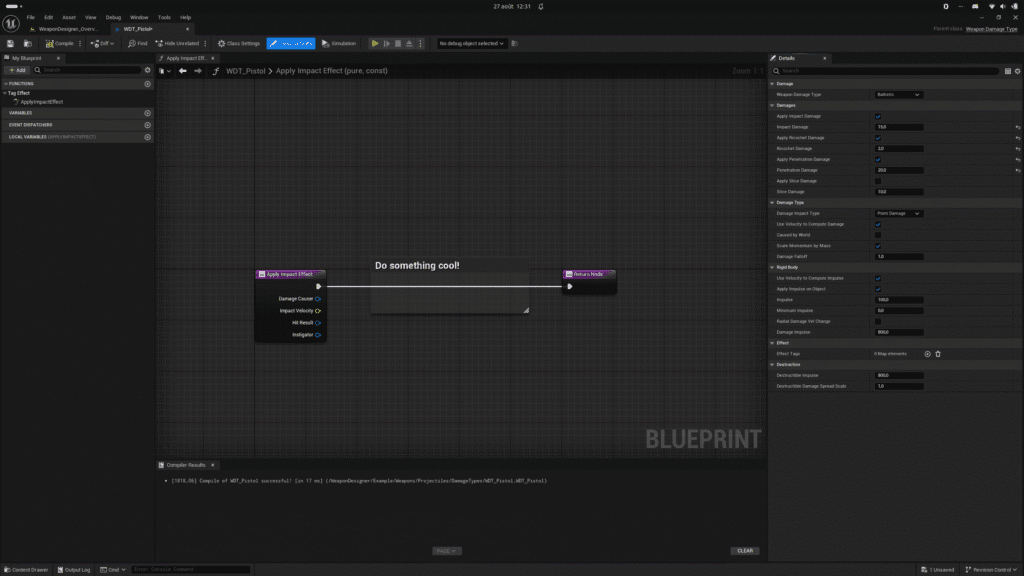
- Define the damage type of the projectile/blade.
- Define what type of damage this can be sent.
- Define the damage amount for each damage type (Ricochet, Crossing, Impact, Slice).
- Define the event that will be used for damage (Point, Radial, Radial with falloff).
- Define the physics effect that will be sent (Impulse).
- Define the tag effect for advanced damage effect like fire or electricity damage. It’s completely optional.
- Override if you want the Apply Impact Effect function.
WEAPON DAMAGE TYPE #
There are several different types of damage. In Weapon Designer, they have been divided into four categories:
- Cutting: Applying force along a sharp edge to separate tissues. Example: Sword (in a slashing motion), dagger, axe, saber.
- Piercing: Concentrating all force on a tiny point to maximize pressure and penetrate a surface. Example: Rapier, spear, dagger (for thrusting), arrows, crossbow bolts. Possibly a firearm bullet.
- Crushing: Transfer of a large amount of kinetic energy across a flat or curved surface, without directly penetrating the surface. Example: Club, war hammer, shield (shield bash), hands.
- Ballistic: A very high-velocity projectile penetrates the body. Unlike an arrow (which is purely penetrating), the bullet deforms, tilts, or fragments inside the body, causing a hydrostatic shock wave. Example: Pistol, assault rifle, sniper rifle.
A weapon can cause several types of damage, such as war hammers with a spike on the back (Crushing-Piercing) or heavy sword (Slashing-Crushing). Currently, the default implementation does not use this information to affect the damage dealt to an actor. You can override the functions Apply Ricochet Damage, Apply Penetration Damage, Apply Impact Damage, etc., to take this information into account.
IMPACT DAMAGE TYPE #
You can select the type of impact damage that will be applied to the actor. These are the engine’s built-in types:
- Point Damage.
- Radial Damage.
- Radial Falloff Damage.
Most of the time, you’ll want to use Point Damage, which concentrates the damage at a single point. For grenades, for example, you’ll need to use Radial Falloff Damage to inflict area damage and check whether an actor is hidden by an obstacle, which would reduce some of the damage.
Effect Tags #
This TMAP will allow you to add additional damage types, such as fire, electricity, magic, etc. Define the tag name (FName) and its associated value (float), and use this variable to calculate the damage dealt to the actor.


